


Many energy systems today generate not only electricity, but also complex data streams. Especially where surplus electricity is to be put to economic use, however, it is not enough simply to display data. What matters is that it is captured, checked and translated into concrete control decisions in real time.
This is exactly what HashLink was developed for. It is the in-house automation and software platform of HASHLYNK and combines measurement, data logic and control into a system that makes energy flows controllable more precisely, faster and more economically.
What you will learn in this article
- what automation specifically means in the context of HASHLYNK
- how HashLink processes data and derives decisions from it
- what effect HashLink can have in existing energy systems
- why automated surplus utilisation makes more economic sense than rough or manual control
Insight
HashLink is not a separate add-on tool, but the software component that enables HASHLYNK systems to put surplus electricity to use in a site-specific, automated and precise way.
Why automation is decisive in the energy system
Automation has long been standard in many technical fields. In the energy sector, it is particularly important where generation, consumption, storage, feed-in and flexible loads all come together at the same time. Without automation, a lot of manual effort quickly builds up – and economic potential remains untapped.
This applies above all to sites with surplus electricity. If surplus energy can only be controlled roughly, with a delay or not at all, inefficiencies arise: energy is put to less effective use, power is adjusted inaccurately, or there are even unwanted grid imports.
HashLink comes in at exactly this point. It monitors energy flows automatically, detects relevant states in real time and ensures that surplus is deliberately directed into an economically sensible path.
What HashLink does at its core
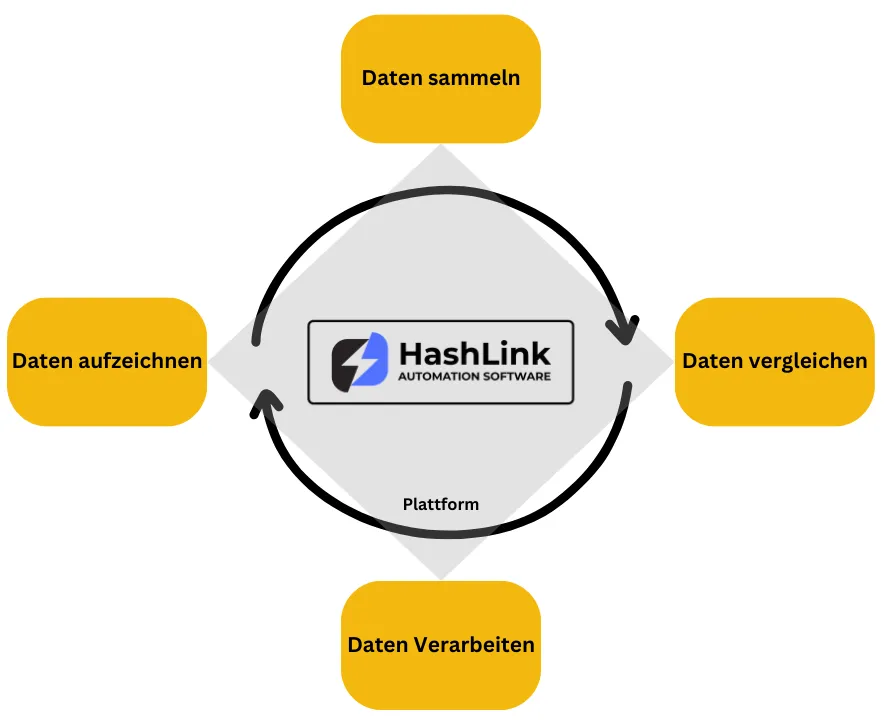
The function of HashLink can be divided into four steps:
1. Capture data
HashLink collects measurement data from internal and external sources. In HASHLYNK platforms such as EcoHash, internal states are provided via the system bus. External energy data can be captured at defined measurement points in the energy system or integrated via existing interfaces.
This makes HashLink relevant not only for systems built entirely from scratch, but also for sites that already have measurement infrastructure in place.
2. Validate data
Before HashLink makes decisions based on incoming values, the data is checked automatically. If values lie outside defined ranges or behave implausibly, the system detects these deviations and responds with error messages or a predefined safe state.
This validation is not only technically important, but also relevant to operation: it reduces wrong decisions and increases the reliability of the control.
3. Process data and derive rules
After capture and validation, the data is processed by internal algorithms. This results in concrete control decisions for the system. HashLink works primarily on the basis of internal logic, but can also be influenced by external parameters.
This is decisive, because it means states can not only be documented but actively changed. Measurement becomes control.
4. Record and evaluate data
All relevant results and the parameters used for decisions are documented and stored. This means system behaviour, operating states and optimisation potential can not only be viewed live, but also evaluated retrospectively.
State of development
Good to know
HashLink is currently still being developed further. Initial versions are being used selectively in chosen projects and pilot sites. That is precisely why the platform is particularly exciting for operators who want to extend or improve existing systems in a targeted way.
From measurement point to decision: how HashLink works
The real added value of HashLink arises where data is not just collected, but translated into operational decisions. A reading alone does not improve an energy system. Only when it leads to a fast and precise response does automation become economically relevant.
HashLink takes care of exactly this translation. The platform detects whether energy is being fed in or drawn from the grid, continuously processes this information and derives a suitable power adjustment for the connected platform from it.
This creates a digital control loop that works much faster and more finely than rough manual control.
What HashLink can achieve in practice
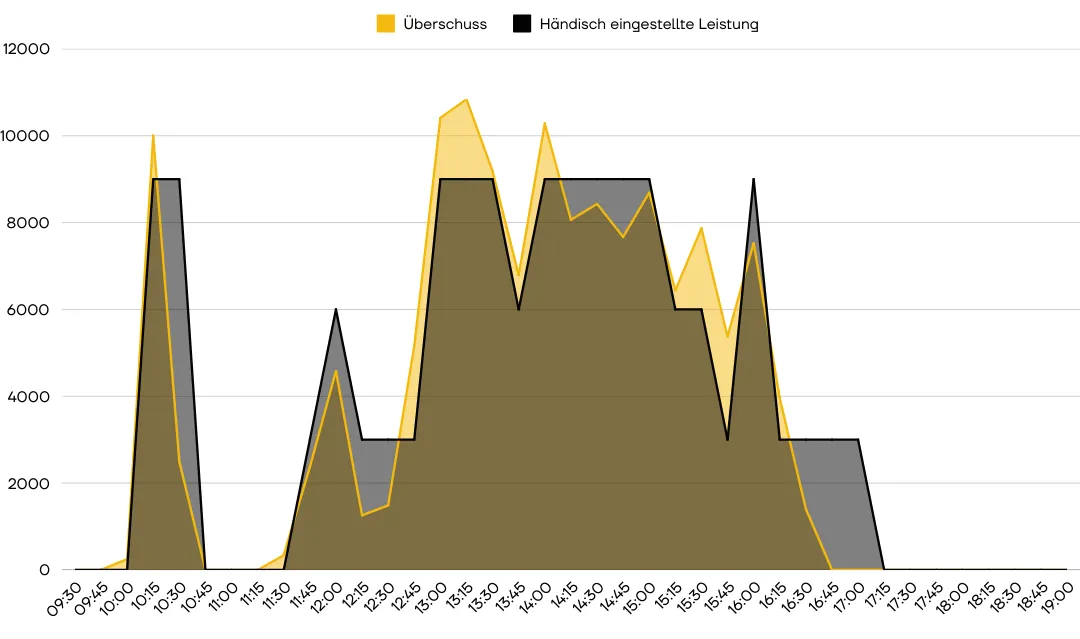
A good comparison is surplus utilisation at a test site. There, in sunny conditions, a defined surplus is available after self-consumption and battery charging. In principle, this surplus can be used for additional utilisation. The only question is: how precisely can this be done?
Manual or rough control
Without integrated automation logic, surplus utilisation is often only possible to a limited extent. In practice, this usually means: readings are captured too rarely or not finely enough, settings are only made in coarse power steps, there is a delay between measurement and response, and deviations lead more quickly to grid imports or untapped potential.
The result is an unsteady control loop with a higher quantisation error and poorer adaptation to real generation curves.
Automated control with HashLink
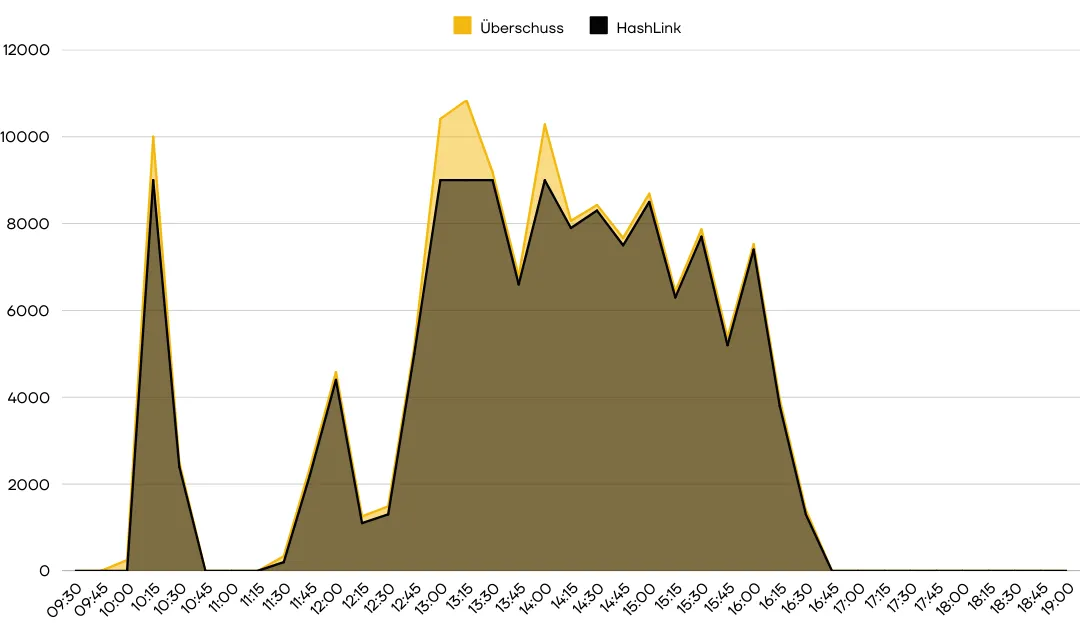
With HashLink, measurement data is integrated directly into the system and processed at short intervals. Power is adjusted not only automatically, but much more finely. In the test case described, the logic is based on a defined sampling time, small power step sizes and a direct link between measurement and utilisation system.
This allows HashLink to calculate the power adjustment dynamically, respond faster to changes in generation, reduce quantisation errors and avoid or significantly reduce grid imports in the utilisation path.
Why this is economically relevant
The difference between manual and automated surplus utilisation is not only technically interesting – it has direct economic consequences. The more precisely a system detects and uses surplus, the less energy is lost or handled under unfavourable conditions.
HashLink therefore does not simply make a platform easier to operate. It improves the quality of the entire utilisation path. That is exactly what makes it so relevant for existing energy systems, energy communities and sites with dynamic energy flows.
Which sites HashLink is particularly interesting for
HashLink makes sense above all where surplus electricity is not only to be made visible but actively controllable, existing energy systems already have measurement points or interfaces, utilisation paths are to be controlled more precisely, rigid on/off logic is not economically sufficient, or several components need to be integrated into shared energy management.
Especially at more complex sites, the advantage lies not in a single feature, but in the ability to translate electrical reality into control logic.
Conclusion: HashLink turns data into a controllable utilisation path
HashLink is the automation component behind HASHLYNK systems. It does not just collect data, but checks, processes and documents it in such a way that concrete operational decisions result from it.
For operators, this means less manual intervention, a more precise response to surplus, better integration of existing systems and a more economically sensible use of the available energy. This is exactly where the real value of HashLink lies.


